-
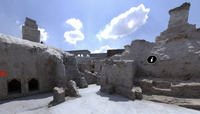 Virtual tour of the Shatby Necropolis in 3D
 A 360° virtual tour of the Shatby necropolis 3D representation allows the user to digitally visit the archaeological site online. Interactive spots guide the users in a virtual path within the 3D representation of the hellenistic necropolis of Shatby. The user, through informative spots, has the possibility to learn about the interdisciplinary and holistic study applied to the monument, its state of conservation and preservation as well as the activities aimed at its valorisation.
-
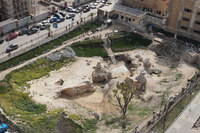 Shatby Necropolis
 The Shatby Necropolis in Alexandria, Egypt, is a captivating historical burial site that bears witness to the city's rich past. Nestled along the Mediterranean coastline, this ancient necropolis is a testament to the diverse cultures that have shaped Alexandria over the centuries. Dating back to the Hellenistic and Roman periods, the Shatby Necropolis is characterized by intricately designed tombs, mausoleums, and burial chambers. The site features a blend of architectural styles, reflecting the influence of Greek, Roman, and Egyptian traditions. Visitors can explore the remnants of grand structures adorned with ornate carvings, providing insights into the city's cultural and religious practices during its heyday. The Shatby Necropolis stands as a poignant reminder of Alexandria's role as a crossroads of civilizations, preserving the stories of those who once called this vibrant city home.
-
 Le dieci formelle della Porta del Paradiso di Lorenzo Ghiberti
 The Gates of Paradise in the Florence Baptistery, created by Lorenzo Ghiberti between 1427 and 1452, is recognised as one of the works that marked the transition from the Medieval Art to Renaissance Art by art critics. The bas-reliefs of the ten bronze panels showcase, from both an iconographic and a technical point of view, a marked difference from the previous production, even by the same master. The element that endures through this change is the narrative function of art; in the Christian art, the figurative language continues to play an important catechetical role. In order to fully understand the meaning of the transfigured text, it is necessary, both today and in the past, to possess the reading codes. Over the centuries these codes have gradually been lost, thus making the scenes depicted in the door partially ‘mute’. The video is aimed at analysing and restoring, through 3D modelling and animation, the events that took place within the ‘landscape of the panels’, creating a renewed and more immediate reading. La porta del Paradiso del Battistero di Firenze, realizzata da Lorenzo Ghiberti tra il 1427 e il 1452, è riconosciuta dalla critica artistica come una delle opere che segnano il passaggio dall’arte medievale a quella rinascimentale. I bassorilievi delle dieci formelle bronzee palesano, sia dal punto di vista iconografico che da quello tecnico, una marcata differenza rispetto alla produzione precedente, anche dello stesso maestro. L’elemento che permane nel mutamento è la funzione narrativa dell’arte; in quella cristiana il linguaggio figurativo continua infatti a svolgere un’importante funzione catechetica. Per poter comprendere pienamente il significato del testo trasfigurato è necessario, oggi come allora, possedere dei codici di lettura; nel corso dei secoli tali codici sono andati progressivamente persi, rendendo in parte ‘mute’ le scene raffigurate nella porta. Il video, realizzato in collaborazione del l'Opera di Santa Maria del Fiore, è finalizzato all’analisi e alla restituzione, mediante modellazione e animazione 3D, degli avvenimenti che hanno luogo all’interno del ‘paesaggio delle formelle’, consentendone una rinnovata e più̀ immediata lettura.
-
Modellazione numerica e analisi del comportamento strutturale del battistero di San Giovanni a Firenze
L'analisi del comportamento strutturale di un edificio monumentale, sia per effetto dei carichi gravitazionali di esercizio, sia per effetto di carichi eccezionali (quali, ad esempio, l’azione sismica), necessita di un’interazione tra diverse strategie di analisi e di modellazione. Anche le recenti “Linee guida per la valutazione e riduzione del rischio sismico del patrimonio culturale”, nel caso specifico della caratterizzazione del rischio sismico, propongono un percorso di analisi integrato su tre distinti livelli di valutazione, caratterizzati da un crescente approfondimento di conoscenza del monumento oggetto di studio. Nell’ambito delle tecniche di analisi strutturale, la tecnica degli elementi finiti si è confermata negli ultimi decenni uno strumento sufficientemente affidabile per la realizzazione di un modello numerico globale del bene monumentale. Lo strumento numerico, infatti, pur nelle incertezze intrinsecamente presenti nel caso della modellazione di edifici storici, può risultare un efficace ausilio capace di fornire utili informazioni interpretative del comportamento strutturale della fabbrica. Occorre comunque sempre evidenziare, e questo in modo particolare nel caso di edifici storici a carattere monumentale, che la modellazione numerica, al pari di altri più semplici strumenti, è uno, e non l’unico, degli strumenti che consentono di esprimere un giudizio qualitativo e quantitativo sullo stato di conservazione di una costruzione. Nel campo della modellazione di edifici a carattere monumentale, infatti, lo strumento numerico è uno strumento che, a maggior ragione, deve trovare validazione in un costante controllo con l’evidenza fisica. È infatti il costante confronto tra risultati sperimentali e numerici che può consentire di giungere a valutazioni affidabili circa l’effettivo comportamento strutturale del bene, identificando le cause di eventuali dissesti. Nondimeno, e pur sempre con le necessarie semplificazioni, un modello numerico costruito sulla base di un rilievo geometrico, esaustivo nella identificazione degli elementi architettonici aventi funzione strutturale, è un prezioso punto di partenza per la realizzazione di un modello strutturale affidabile nei risultati e utile per la rappresentazione della realtà fisica. Ed in questo senso il passaggio dalla realtà architettonica alla geometria strutturale è il passaggio chiave di una prima parte del percorso di analisi. Il modello numerico deve, infatti, essere realizzato partendo da un rilievo architettonico e geometrico sufficientemente accurato sul quale, consapevoli dei rapporti storici, architettonici e costruttivi, si sviluppa la prima operazione interpretativa della realtà strutturale operando le necessarie semplificazioni. Tanto più accurato è il rilievo, tanto più consapevoli possono essere le schematizzazioni di carattere strutturale. Questa operazione, sempre valida e necessaria in un bene monumentale, è ancora più eloquente nel caso del Battistero fiorentino dove forma architettonica e forma strutturale si uniscono in un tutt’uno inscindibile. Il Battistero è stato oggetto nell’ultimo anno (2014) di un’articolata campagna di indagini conoscitive, sia sperimentali sia numeriche, promossa dall’Opera del Duomo di Firenze e la memoria discute alcuni dei risultati ottenuti in merito all’identificazione statica del monumento. Sulla base di un esaustivo e dettagliato rilievo eseguito con tecnica laser scanner è stato realizzato un modello numerico agli elementi finiti della fabbrica, impiegato per offrire una prima interpretazione del comportamento strutturale del Battistero. Particolare attenzione è stata posta al flusso delle tensioni, del quale viene valutata la compatibilità con il quadro quadro fessurativo rilevato. I risultati ottenuti, riassunti nella memoria, si propongono come una prima valutazione circa la sicurezza del monumento, ed offrono delle indicazioni per successivi approfondimenti di indagine. Infatti, l’avvicinamento alla comprensione del funzionamento di monumenti complessi, come è il caso del Battistero di San Giovanni dove forma e struttura si fondono in un tutt’uno inscindibile, non può che procedere per fasi, in quanto possibili approfondimenti di indagine e di analisi possono essere meglio individuati a seguito di una prima comprensione della statica del monumento.
-
A multi-analytical approach for the study of red stains on heritage marble
Red stains are a common discolouration on stone cultural heritage all over the world. These are very difficult to remove and little is known about the reddish pigmentation. Numerous red stains were mapped on the Baptistery of San Giovanni in Florence, one of the most important monuments in Italy. This paper is focused on red stains on marble stone and the results of a detailed multidisciplinary approach are presented. Several analytical and investigation techniques (such as optical microscopy, X-ray fluorescence mapping, X-ray micro-tomography, micro-Raman spectroscopy, scanning electron microscopy with energy dispersive spectroscopy, microbial isolation, colorimetric measurements and isotopic analyses) were used to better understand the origin and processes involved in this kind of alteration. Analyses of the red stains led us to believe the presence of minium (lead tetroxide) and Pb are usually concentrated in the spaces between calcite grains. Red stains of Pb isotopic composition also overlap with data from Sardinian mines. These preliminary data seem to reinforce the suggestion of a source of lead from some metallic items (during restoration campaigns between 1938 and 1944, damaged parts were removed and replaced, and the new marble cladding was fixed with iron brackets treated with minium).
-
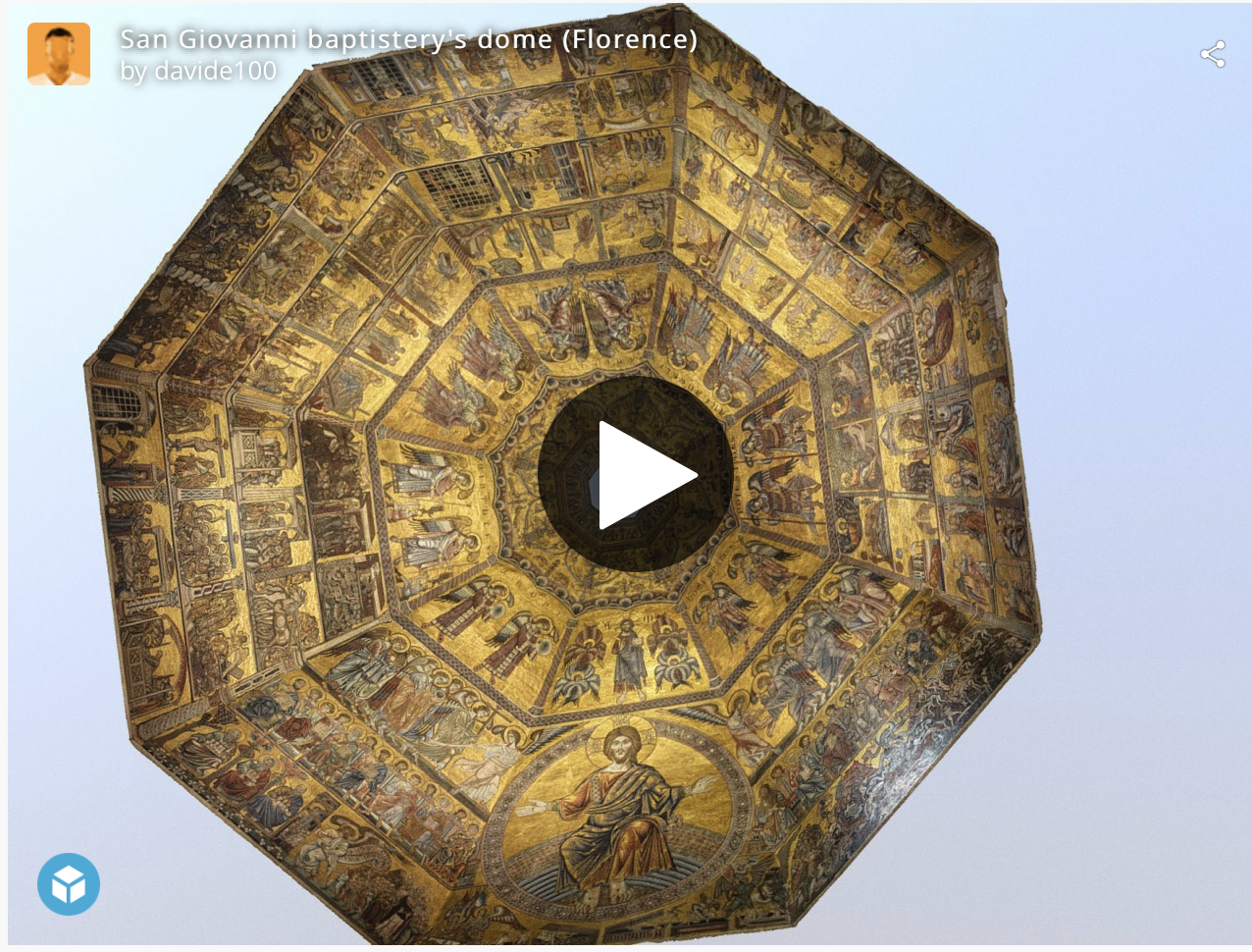 3D Model of San Giovanni Baptistery's Dome (Florence)
 This is the 3D model of the dome of San Giovanni baptistery in Florence. The Baptistery is crowned by a magnificent mosaic ceiling. The earliest mosaics date from 1225. It was probably not completed until the fourteenth century. The mosaics are done in a Byzantine style, with iconic figures and a gold background. This mosaic cycle depicts the Last Judgement with a gigantic, majestic Christ and the Angels of Judgement at each side, the rewards of the saved leaving their tomb in joy (at Christ’s right hand), and the punishments of the damned (at Christ’s left hand). This last part is particularly famous: evil doers are burnt by fire, roasted on spits, crushed with stones, bit by snakes, chewed by hideous beasts. The other scenes on the ceiling depict different stories: (starting at the top) Choirs of Dominations, Powers, Archangels, Angels, Principalities, Virtues and Thrones; stories from the Book of Genesis; stories of Joseph; stories of Mary and the Christ and finally in the lower tier stories of Saint John the Baptist.
-
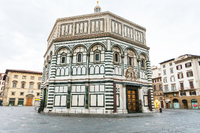 Baptistery of Saint John in Florence
 The Baptistry of St. John, located in the heart of Florence, Italy, is a magnificent architectural gem that stands as one of the city's most iconic landmarks. This octagonal structure, known as the Battistero di San Giovanni in Italian, boasts a rich history dating back to the early Christian era. Constructed between the 11th and 12th centuries, the Baptistry is renowned for its stunning Romanesque design. The exterior is adorned with white and green marble, showcasing intricate patterns and reliefs that tell biblical stories, including scenes from the life of St. John the Baptist. The Baptistry's crowning glory is its gilded bronze doors, particularly the famous "Gates of Paradise" designed by Lorenzo Ghiberti, which are adorned with exquisite biblical scenes and represent a masterpiece of Renaissance art.
Inside the Baptistry, visitors are captivated by its vast, cavernous space and the awe-inspiring mosaic dome that dominates the interior. The ceiling is adorned with breathtaking mosaics that narrate scenes from the Last Judgment and the life of St. John the Baptist. The serene ambiance within the Baptistry, filled with the soft hues of the mosaics and the echo of harmonious acoustics, creates a truly spiritual and transcendent experience. The Baptistry of St. John remains a significant religious and historical site in Florence, attracting tourists and art enthusiasts from around the world who come to admire its architectural grandeur and immerse themselves in the rich cultural heritage of this remarkable city.
-
Implementing the 4CH Vision
Presentation of the 4CH vision implementation, given at the 4CH (Competence Centre on the Conservation of Cultural Heritage) by the Technology Coordinator Prof. Franco Niccolucci.
-
D2.1 Report on CCs analysis
The main goal of the 4CH Project is to set up the methodological, procedural, and organizational framework of a European Competence Centre (CC) about Cultural Heritage (CH) able to seamlessly work with a network of national, regional, and local cultural Institutions, providing them with advice, support, and services.
This report describes the survey results on existing Competence/Knowledge Centres and other similar entities, implemented with the aim to get useful feedbacks and lessons learnt to outline the future 4CH Competence Centre (4CH CC) organization, governance, funding and business plan, provision of services and other related and relevant aspects.
-
 DANS Data Game
 DANS has developed a game especially for researchers: the DANS Data Game. The game gives an impression of the research data landscape and was specially produced for the 15th anniversary of DANS. The game can also be used in Trainings to engage researchers and start discussions. The game can be ordered online free of charge and will later also be available digitally.
-
CIDOC CRM Game
CIDOC CRM the Game is an open source initiative that aims to promote wider adoption of the CIDOC CRM standard through facilitating the learning process for beginning users/learners. The game materializes the CIDOC CRM ontology as a card game consisting of 3 basic decks. There are different scenarios available, which relate to actual cultural phenomena. There are tabletop versions and downloadable digital versions (for an online version, see OntoMatchGame). This record is a collective record for five different games, four tabletop versions and one digital version, developed between 2015 and 2021.
-
Getty Vocabularies Training Materials
A webpage listing PDF documents of presentations and other training materials for the Art & Architecture Thesaurus (AAT)®, the Getty Thesaurus of Geographic Names (TGN)®, the Union List of Artist Names (ULAN)®, the Cultural Objects Name Authority (CONA)®, the Getty Iconography Authority (IA)™, Categories for the Description of Works of Art (CDWA), Cataloging Cultural Objects (CCO), and standards in general. The materials are subject to frequent modification and addition.
-
Google Earth Engine Tutorials
Google Earth Engine tutorials (video and PDF handouts with exercises) focused on monitoring cultural heritage. Made by the Endangered Archaeology in the Middle East and North Africa (EAMENA) project as part of the British Council CPF funded training programme.
-
 4CH Risk Visualiser
 4CH Cloud-based online web service for real time monitoring of environmental risks on Cultural Heritage
-
 ARIADNE Portal
 The ARIADNE Portal brings together existing archaeological research datasets from ARIADNE partners so that researchers can browse and access the various distributed datasets for use in their projects.
The portal also provides a point of access for the new services developed by the project.
-
 ARIADNEplus Data Management Plan Tool and Templates
 ARIADNEplus offers an online Data Management Plan Tool which supports archaeological data managers and archaeologists who want (or are obliged to) make a data management plan for producing and sharing data that comply with the FAIR data principles (see: https://www.go-fair.org/fair-principles/).
A complication is that the requirements for a DMP, although similar in intention, vary across research funders and organisations. Therefore ARIADNEplus currently provides the tool with three DMP templates:
* the Protocol for Archaeological Data Management, which is based on the widely recognised Science Europe guidance for research data management and the principle of “comply or explain”.
* the ARIADNEplus DMP Researcher Template for Archaeological Datasets, developed from the Horizon 2020 requirements and tailored to community standards and practices:
* the Horizon Europe Template for Archaeological Datasets which includes links to information and suggestions for answering the questions of the template; the related guide can also be consulted for the above protocol and template: https://training.ariadne-infrastructure.eu/dmp-guidance/
-
 Vocabulary Matching Tool
The Vocabulary Matching Tool allows users to align Linked Data vocabulary concepts with Getty Art & Architecture Thesaurus concepts. The tool is a browser based application that presents concepts from chosen source and target vocabularies side by side, exposing additional contextual evidence to allow the user to make an informed choice when deciding on potential mappings (expressed as SKOS mapping relationships). The tool is intended for vocabularies already expressed in RDF/SKOS and can work directly with the data – querying external SPARQL endpoints rather than storing any local copies of complete vocabularies. The set of mappings developed can be saved locally, reloaded and exported to a number of different output formats.
-
 FastCat - A Collaborative Data Entry and Curation Tool
 FastCat is a Web-based system designed for historians and other researchers who need to manually digitize structured and semi structured archival documents in a fast and accurate way to create their research dataset. It combines the ease of use and quick data entry functions of the classic spreadsheet with the information accuracy typically associated with a complex database. It does so by offering data entry templates designed to mirror, in the digital space, the structure and data entry logic of the original source.
-
 3M - Mapping Memory Manager
 3M is a tool for managing mapping definition files. It’s based on FIMS management system for the administration of the files and also on the 3MEditor for editing and viewing the files. It provides a number of administrative actions that assist the experts to manage their mapping definition files. 3M is available online and is free to use. The source code is open source and available on github.
-
X3ML Toolkit
The Centre for Cultural Informatics works as competence center for the CIDOC CRM (ISO 21127), by building up and exchanging application know-how, consultancy to implementers and researchers, and contribution to the dissemination, maintenance and evolution of the standard itself. CCI in collaboration with CIDOC for the last 20 years, received basic empirical input and developed a significant number of mapping specifications using a formalism based on the declaration of equivalences and the interpretation of each source schema as a set of nodes and links. Such mappings were used to validate the CRM. The X3ML mapping definition language, a declarative XML language, was the culmination of this experience and formalism. It describes schema mappings in such a way that they can be collaboratively created and discussed by experts who are able to produce the semantics of a mapping. It is human and machine readable and is the ultimate communication means on the semantic correctness of the mapping.
Following the X3ML definition, we developed and used an efficient transformation algorithm which processes the declarative X3ML statements and produces equivalent rdf statements. Different cases of semantic heterogeneity that were encountered in different applications are covered. In parallel, the CIDOC CRM SIG started working on the SYNERGY framework, a rich and comprehensive Reference Model for a better practice of data provisioning and aggregation processes, primarily in the cultural heritage sector, but also for e-science. The aggregation of heterogeneous data from different institutions has the potential to create rich data resources useful for a range of different purposes, from research to education and public interests. Along this line, CCI has developed the X3ML Toolkit, a set of small, open source, microservices that follow the SYNERGY Reference Model. They are designed with open interfaces and they can be easily customized and adapted to complex environments. The X3ML Toolkit consists of a set of software components that assist the data provisioning process for information integration. The key components of the toolkit are: (a) Mapping Memory Manager, (b) 3M Editor, and (c) X3ML Engine.
-
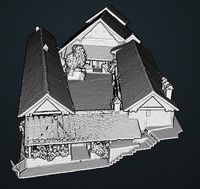 3D Model of the Monastery of Agios Ioannis Lampadistis
 3D acquisition of various areas of the monastery of Agios Ioannis Lampadistis made by the Cyprus Institute
-
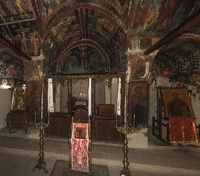 Panoramic view of the Monastery of Agios Ioannis Lampadistis
 A 360° virtual tour of the monastery of Agios Ioannis Lampadistis allows the user to digitally visit the church online. Through interactive spots, it is possible to obtain information about the interdisciplinary and holistic study applied to the monument.
-
 4CH Pilot Case: Ayios Ioannis Lampadistis Monastery (video)
 The video shows one of the 4CH Pilot Cases, the UNESCO site of Ayios Ioannis Lampadistis Monastery on the Troodos Mountains, Cyprus. The work carried out by the Cyprus Institute represents an example of best practices offered by the future 4CH Competence Centre for the conservation, preservation and valorisation of Cultural Heritage. The Cyprus Institute (APAC Labs) organised a day-long programme at the monastic complex for the occasion of the International Day of Monuments and Sites. This highly visual video shows the interdisciplinary work involved and highlights the importance of documenting Heritage for conservation, preservation and valorisation purposes. Such methods include 3D documentation, analysis of the wall paintings and dendrochronological research. Moreover, the engagement of the community and the local stakeholders for this heritage site are an important factor for its future sustainability.
-
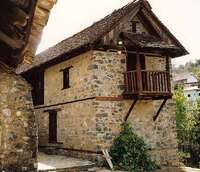 Monastery of Agios Ioannis Lampadistis
 The monastery of Agios Ioannis Lampadistis is situated in a central area of the Troodos mountain range, in the valley of Marathasa. It is built on the east bank of the river Setrachos, opposite of the village of Kalopanagiotis. The exact founding date of the monastery is unknown. The katholicon (monastery church), which is dedicated to Saint Herakleidios, is dated to the 11th century. Among the wall-paintings of the narthex there is an inscription, dated to the 15th century, which describes this church as “katholiki”, i.e. the principal parish church of the village. According to other written sources the monastery functioned until the beginning of the 19th century. Since then it has been used as a church.
The group of buildings which survives today is the result of constructions and renovations of different periods. The main monastery church is a domed cross-in-square structure, dated to the 11th century. In the 12th century the chapel of Agios Ioannis Lampadistis was added to the north of the first church, above the tomb of the Saint. This second chapel collapsed and was almost entirely rebuilt in the 18th century. In the middle of the 15th century a common narthex was built to the west of the two churches. During the second half of the 15th century a vaulted chapel was added to the north of that of Saint Ioannis. It became known as the 'Latin chapel' because of the assumption that it was built for the Latins (Catholics). Sometime between the 15th and the beginnings of the 18th century), a timber roof covered with flat hooked tiles sheltered the entire roof complex. As a result of its tripartite character, the building acquired an external image of a large building covered with a timber roof. Apart from the complex of the three churches there are other monastic buildings including cells, auxiliary rooms and an oil press.
-
 Béatrice Markhoff
 Béatrice Markhoff, received her PhD in Computer Science in 1995. She is Associate Professor at the University of Tours (UNI-TOURS). She teaches at undergraduate level and postgraduate levels, she created a Bachelor on IT Management for Security and participated in the creation of a Master degree on Digital Humanities. She is the head of the database and natural language processing team (BdTln) of LIFAT. Her research activities include knowledge engineering and semantic Web. She applies these topics in the Cultural Heritage area, collaborating to several DH projects. Her works have been published in international conferences such that WebDB, MFCS, ADBIS, IDEAS, DEXA, CAA and journals (e.g. The Computer Journal, ACM JOCCH). She participates in several conference PCs, she is a creator of the Semantic Web for Cultural Heritage (SW4CH) international workshop, and co-supervisor of a special issue of The Semantic Web Journal on SW4CH topics.